


1.1 ml Lip Filler Before and After: What Results To Observe
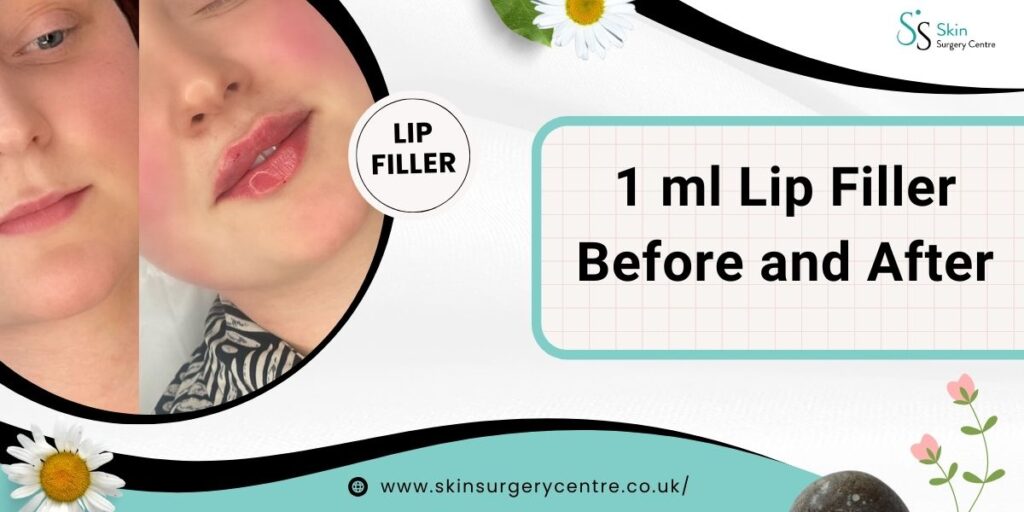
Lip fillers have become one of the most sought-after non-surgical cosmetic enhancements due to their efficiency, customisability, and minimal downtime....
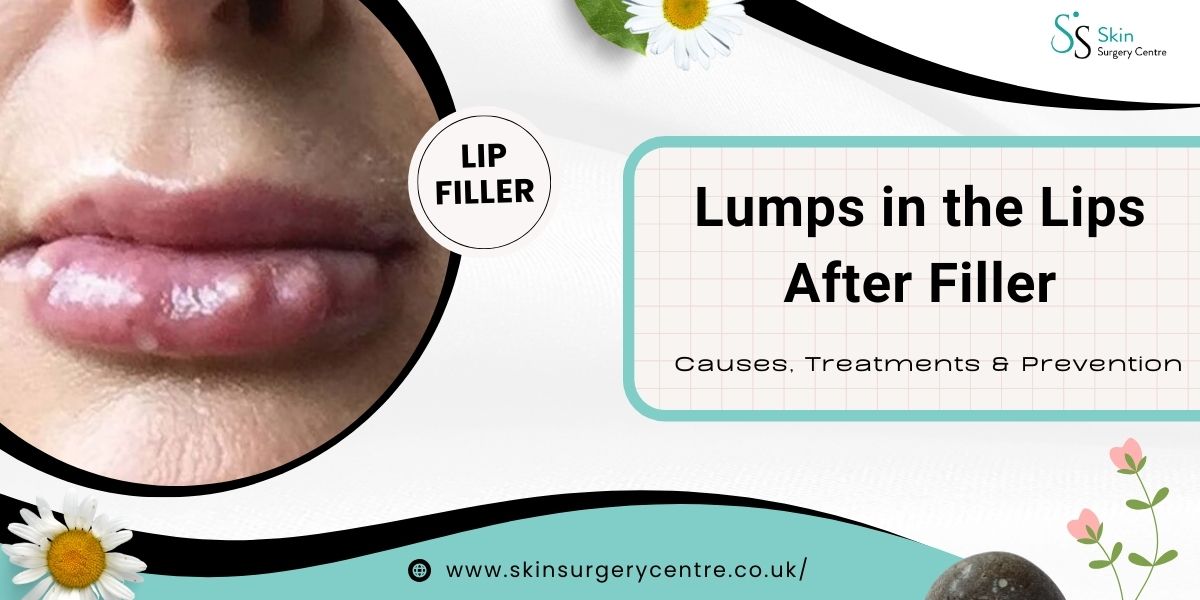
Feeling lumps in your lips after filler can be unsettling, especially if you expected your results to feel smooth straight away. Many people worry that something has gone wrong or that their filler has been placed incorrectly.
Most mild lumps after lip filler are temporary and part of normal healing rather than a complication. Understanding how lips settle in the first few weeks can help you avoid unnecessary worry and know when review is actually needed.
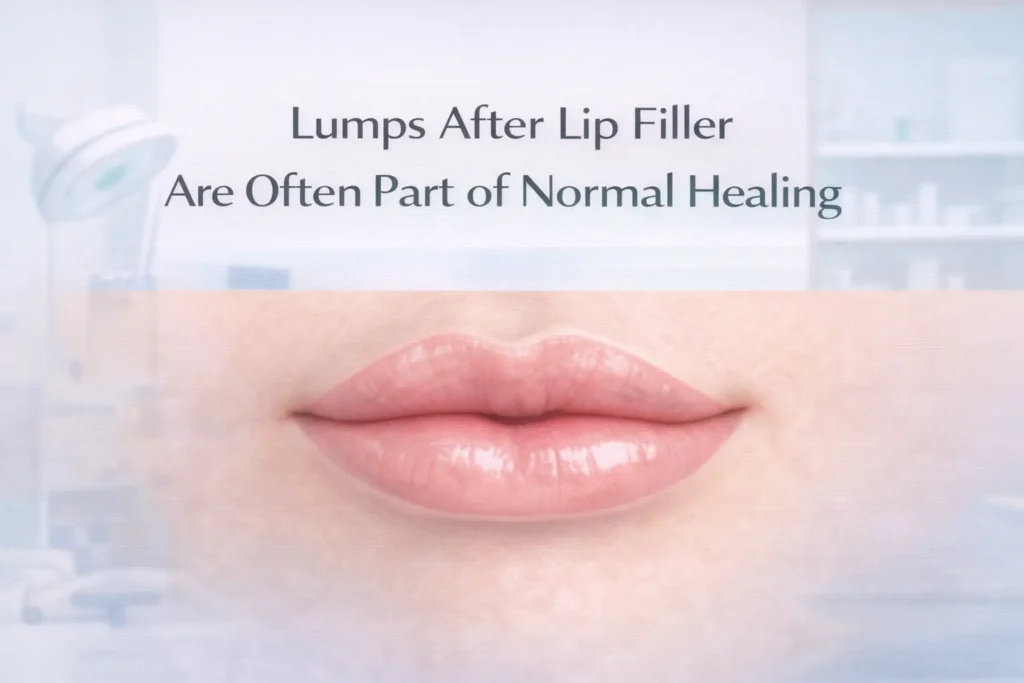
Many people who experience lumps in the lips after filler are simply noticing the normal settling process rather than a complication.
Mild lumps after lip filler are usually normal and often part of the natural healing and settling process. Swelling, bruising, and filler integration can cause temporary unevenness that typically improves within two to four weeks. Soft, painless lumps that gradually improve rarely require treatment. However, firm, painful, or worsening lumps should always be assessed by a qualified practitioner to rule out complications.
If you notice severe pain, significant colour change (pale, white, or dusky skin), or increasing swelling that does not improve, urgent medical review should be sought. Although rare, these symptoms require prompt professional assessment.
Yes. Small lumps after lip filler are common and often part of normal healing following dermal filler treatment. Understanding how lip fillers work can help explain why temporary unevenness sometimes occurs. Mild swelling, filler settling, and tissue integration can create temporary unevenness that usually improves within several weeks.
Lumps that are soft, painless, and gradually improving are typically not a cause for concern, while persistent, painful, or worsening lumps should be assessed by a qualified practitioner.
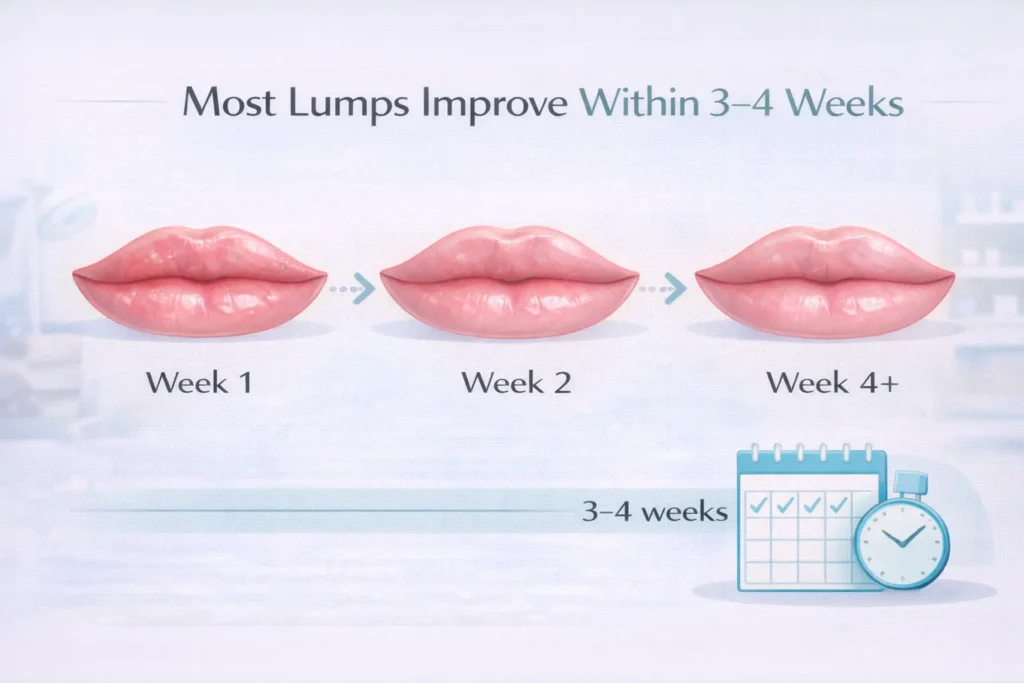
The general healing timeline below explains what most patients experience after lip filler treatment:
| Stage After Treatment | What You May Feel | Is It Normal? |
|---|---|---|
| First week | Swelling, firmness, uneven texture | Yes |
| Week 2 | Small soft lumps or mild asymmetry | Yes |
| Weeks 3–4 | Gradual softening and smoothing | Yes |
| After 4–6 weeks | Mostly smooth lips | Yes |
| Beyond 6 weeks | Firm or unchanged lumps | Review advised |
Most post-filler lumps gradually improve as swelling settles and the product integrates with surrounding tissue. Soft or mild unevenness often resolves within several weeks, although healing time varies between individuals. Monitoring changes over the first month is usually advised before considering corrective treatment, particularly if you are around the two-week settling stage.
During this time, swelling gradually reduces and the filler integrates more evenly with surrounding tissue. As this settling process continues, most mild irregularities soften and become less noticeable.
Lumps formed after lip filler procedures can arise for a variety of reasons. Swelling, among other more technical factors, is one such reason. Let’s break it down:
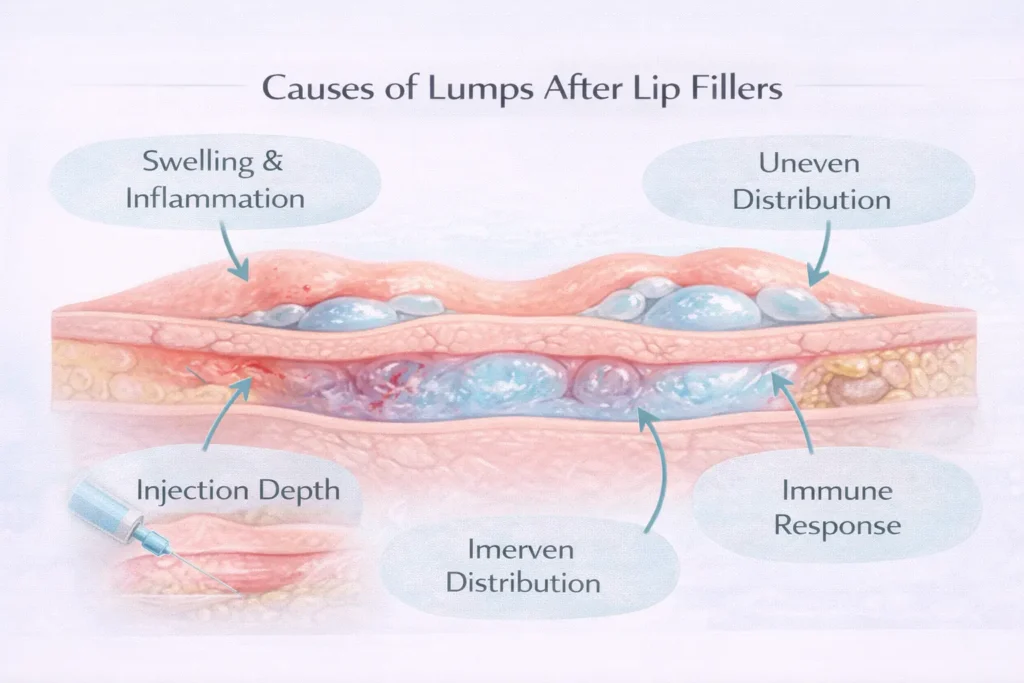
A little swelling is to be expected after undergoing any injection, fillers included. Sometimes this swelling can appear as bumps or lumps under the skin. They usually soften and disappear as the swelling subsides.
Uneven application of filler can also distort lumps. If too much product is injected in a singular area or if the filler is inadequately massaged after injection, lumps can form.
Less commonly, lumps can form due to inflammatory reactions to the filler material, known as nodules or granulomas. Harder or more persistent bumps can form due to these inflammatory responses along with redness or tenderness that accompanies such nodules.
The most notable fillers, especially those containing hyaluronic acid, in rare cases, a delayed inflammatory or immune response may occur, leading to firmer or more persistent lumps that require professional review. Lumps caused by this can be more gradual, appearing days after the procedure rather than immediately.
A poorly administered injection may lead to the filler being trapped. This can happen if the filler is injected too superficially, in a hurry, or without proper post-injection massage.
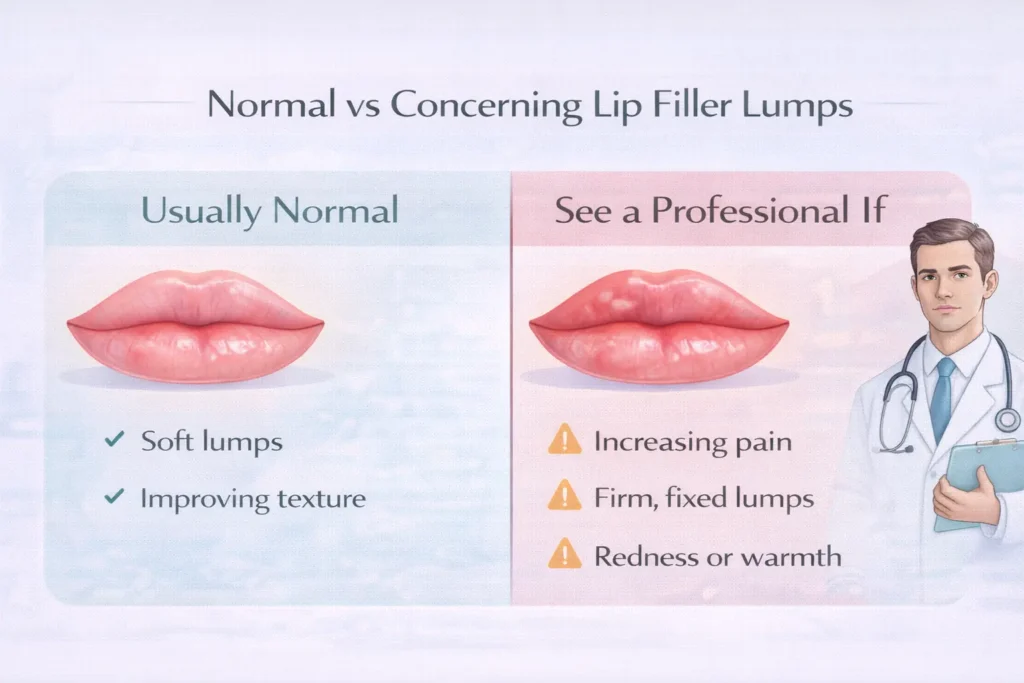
Most post-filler lumps are temporary and improve as swelling settles. Lumps are typically considered part of normal healing if they:
• feel soft or mildly firm
• are not painful
• gradually improve over time
• change as swelling reduces
• appear within first few weeks after treatment
These types of lumps usually settle naturally as the filler integrates and the lips soften.
In clinical practice, it is very common for lips to feel uneven for several weeks after filler treatment. Most mild lumps settle naturally as swelling reduces and the product integrates with the tissue.
Experienced practitioners usually recommend allowing adequate settling time before considering correction, as early intervention is rarely necessary unless symptoms worsen.
In the UK, dermal fillers are regulated as medical devices by the MHRA, and safe treatment requires appropriate clinical training, product selection, and complication management knowledge. Choosing a medically trained practitioner significantly reduces the risk of persistent nodules or poorly placed filler.
Not all lumps are the same, and knowing which type aids in proper management. The following are the primary types:
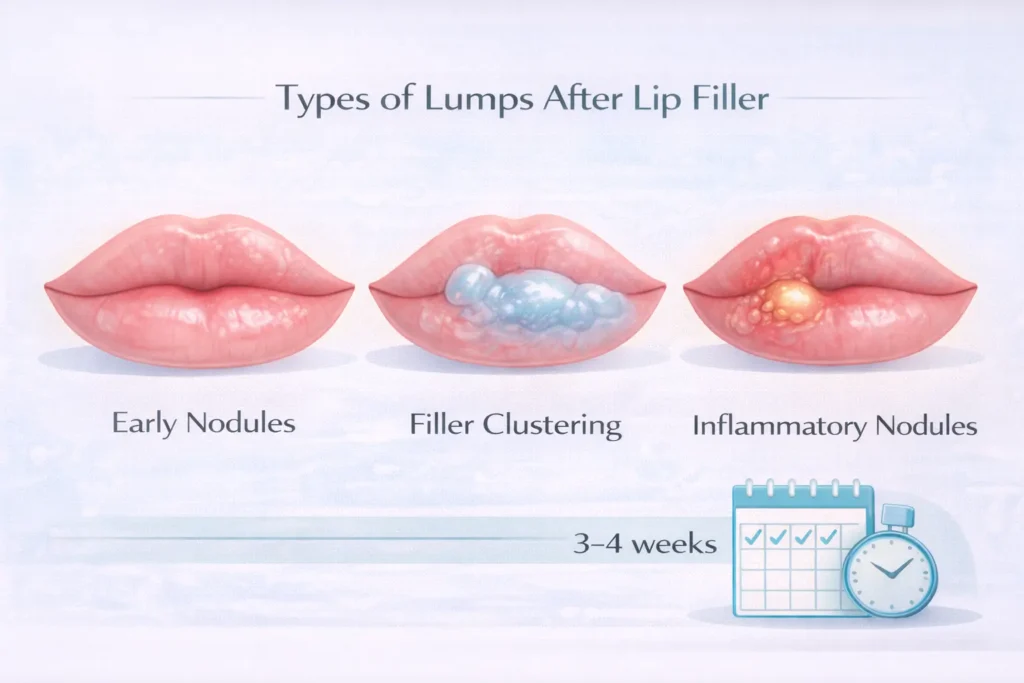
These lumps are commonly due to swelling or bruising and are very common in the first 1-3 days after the procedure. They are soft and mild to touch, and fade away quite easily with some time and minimal effort.
Sometimes, the filler might have been evenly distributed, and may leave behind lumps that can be felt under the skin. This is more common with insufficient technique or low-grade filler products.
If the lumps have associated redness along with pain or heat sensation, they might be due to fever or infection and inflammatory sequela. These require more immediate attention from a medical professional.
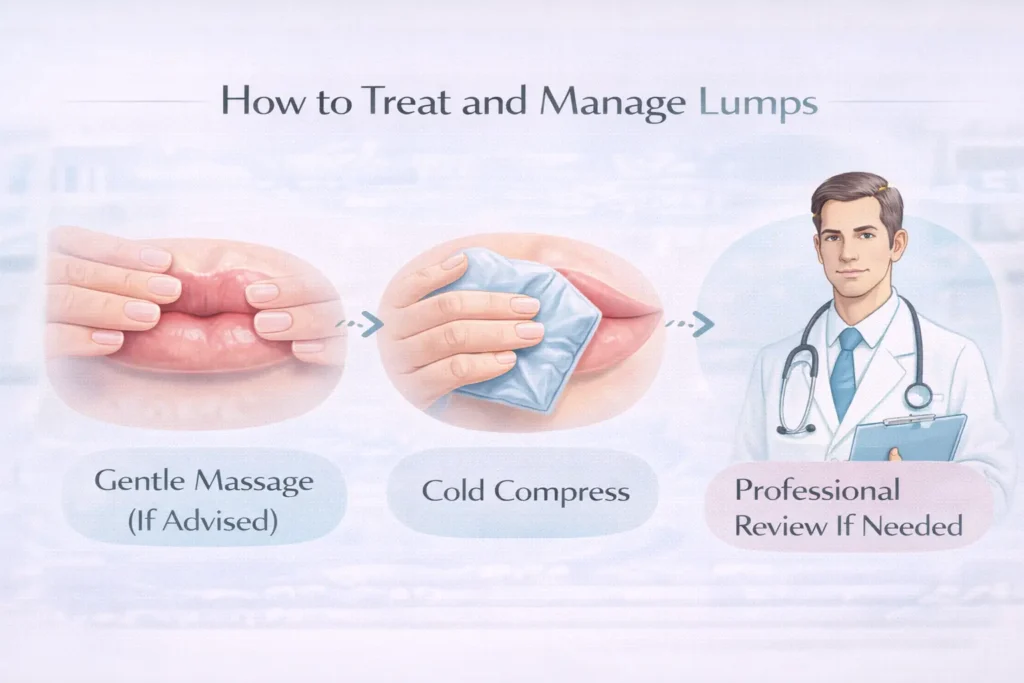
While most lumps will go away on their own, some will require treatment in a way that guarantees the best outcomes. These treatments differ from self-directed care at home to seeking help from your injector or a professional dermatologist.
If you want to reduce the appearance of lumps, gentle massage should only be performed if specifically advised by your practitioner. Incorrect or aggressive massage can worsen swelling or move filler unevenly. When in doubt, professional guidance is safer than self-treatment.
Hyaluronidase is commonly used to dissolve hyaluronic acid-based fillers and remove them safely when lumps have formed as a result of fillers being misplaced. For justified stubborn fillers, this option will always be the preferred choice.
If lumps remain firm, painful, or unchanged after several weeks, a qualified practitioner may assess whether treatment such as dissolving, medication, or further evaluation is appropriate. Management depends on the underlying cause and should always be guided by a trained medical professional.
Lip filler lumps should not be aggressively massaged or manipulated unless specifically advised by your injector. Excessive pressure or incorrect technique can worsen swelling or displace filler. Conservative aftercare and professional guidance are preferred over forceful self-correction.
When uncertain, professional assessment is safer than waiting.
You want to ensure you are choosing the right professional in order to minimise the chance of lumps appearing; these are what you need to focus on:
Make sure that the filler is purchased from reputable brands because those that do not are most likely to cause complications. Unregulated products have a greater percentage of causation due to inflammatories.
The skill level of the injector is important when achieving the desired results. An injector who possesses a high level of experience will have good psychomotor skills and a strong aesthetic appreciation that will help them by achieving the required filler placement.
Always engage with a provider with the highest qualifications and a lot of experience with lip fillers, preferably medically trained and experienced in aesthetic injectable treatments.
In order to minimise your chances of lumps, some preventative measures can be taken both before and after the procedure is done:
Expert Injector: Check the credentials of your provider, and be sure to ask for before-and-after photographs so you can see their work and confirm that they use authentic and licensed fillers.
Discuss Expectations: If it is your initial session, it is advisable to start with a smaller amount of filler so that your provider can assess the way your body responds.
Aftercare: To control swelling and inflammation, try to refrain from vigorous activity, consuming alcohol, and high temperatures for at least 24 hours after the procedure.
Self-Correction: Lumps should not be self-corrected using aggressive techniques. Instead, your injector should be consulted.
Most lumps after lip filler improve naturally as swelling settles and the product integrates with surrounding tissue. Soft or mild unevenness often resolves over several weeks without intervention. If lumps feel persistent, painful, or worsen rather than improve, seeking professional assessment helps ensure appropriate care and reassurance.
A: Yes. Mild lumps or firmness can still be normal at two weeks. Swelling may not have fully settled and the filler is still integrating with surrounding tissue. If lumps are soft, painless, and improving, they usually resolve naturally over the following weeks.
A: Most minor lumps improve within 2–4 weeks as swelling settles and the filler softens. In some cases, it can take slightly longer depending on individual healing and the amount of filler used.
A: Massage should only be done if specifically advised by your practitioner. Incorrect or aggressive massage can worsen swelling or move filler unevenly. When in doubt, professional guidance is safer than self-treatment.
A: Professional review is recommended if lumps are painful, firm, worsening, associated with redness or warmth, or still present after several weeks without improvement.
A: If lumps persist or are caused by filler placement issues, a qualified practitioner may assess whether dissolving with hyaluronidase or other treatment is appropriate.

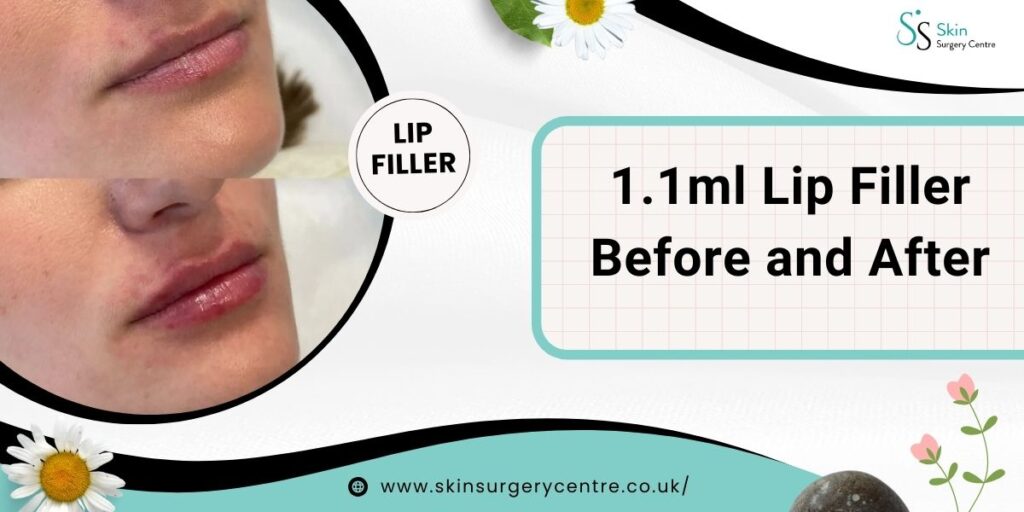
Lip fillers have become one of the most sought-after non-surgical cosmetic enhancements due to their efficiency, customisability, and minimal downtime....
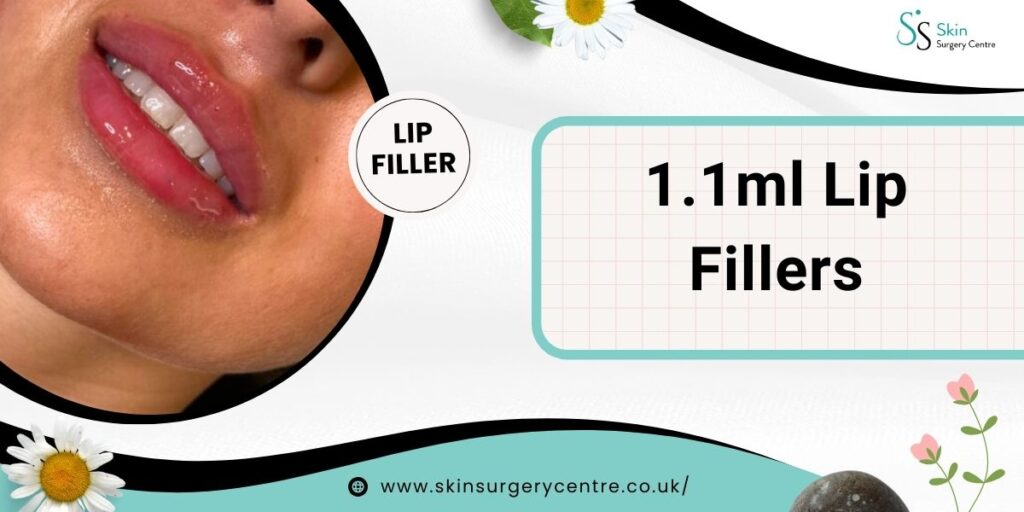
Are you considering ways to achieve fuller, well-defined, and more symmetrical lips with 1.1ml lip filler? Whether this is your...
For people who are thinking about having their lips done, one of the most common questions is, “How much does...
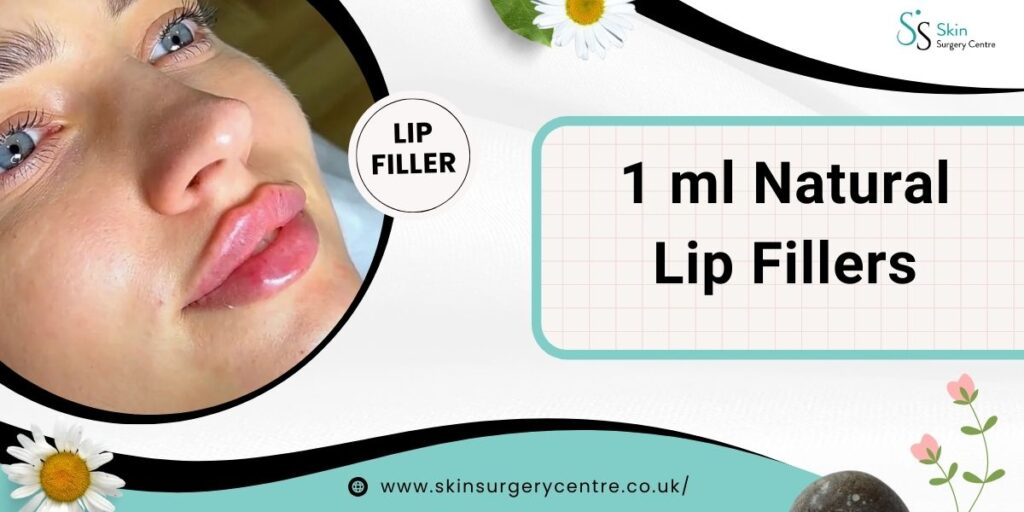
The aesthetic procedure 1ml natural lip fillers is gaining more popularity in this day and age. This particular measurement is...
According to Beauty Tech industry trends, lip augmentation continues to grow in popularity, and for good reason. If you are...