



Quick Facts About Lip Fillers in the UK
- Non-surgical cosmetic treatment using hyaluronic acid gel
- Typically lasts 6–12 months depending on metabolism
- Procedure usually takes under 1 hour
- Swelling and bruising common for first few days
- Should always be performed by trained medical professional
Introduction
Lip fillers remain one of the most searched non-surgical cosmetic treatments in the UK, yet public understanding is often shaped more by social media than clinical facts. Questions about safety, pain, longevity, and natural results continue to dominate search trends.
This guide answers the most common lip filler FAQs, myths, and public concerns using a clear, UK-focused perspective. Rather than promoting treatment, the aim is to provide balanced, medically responsible information so readers can separate online trends from realistic clinical outcomes and make informed decisions about treatment.
This Lip Filler FAQs guide answers the most searched questions about lip fillers in the UK, including safety, pain, longevity, natural results, and common misconceptions. By addressing real public concerns and online myths, this page is designed to give clear, factual answers based on current UK clinical practice rather than social media trends.
Quick Overview: Most Asked Lip Filler Questions
For those seeking immediate clarity on the basics, here are concise, factual answers to the most common queries regarding lip enhancement.
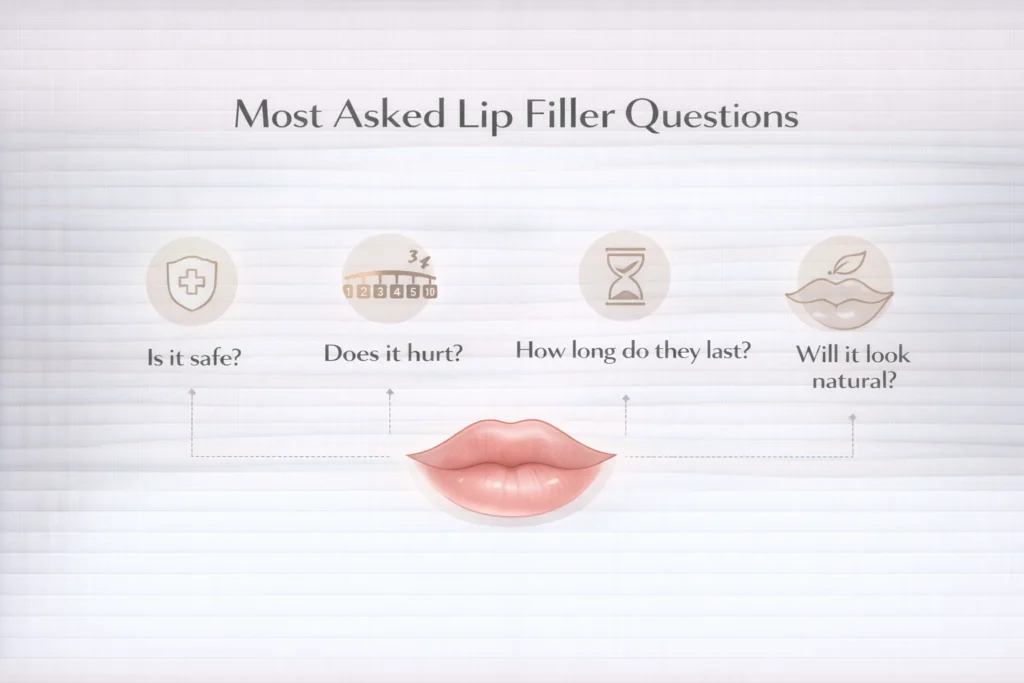
- Are lip fillers safe?
When performed by a medically qualified practitioner using approved products in a sterile environment, the risk profile is generally low. However, like any medical procedure, risks such as infection, vascular occlusion, and migration exist. - Do they hurt?
Most modern dermal fillers contain lidocaine, a numbing agent. Additionally, practitioners often use topical anaesthetic cream. Patients typically report a pinching sensation or mild discomfort rather than acute pain. - How long do they last?
Longevity varies by metabolism, product used, and lifestyle, but results typically last between six and 12 months. They are not permanent. - Are they permanent?
No. Hyaluronic acid (HA) fillers are gradually broken down and absorbed by the body over time. Permanent fillers (like silicone) are largely discouraged in modern UK aesthetics due to high complication rates. - Can they go wrong?
Yes. Poor technique can lead to lumps, asymmetry, or migration (filler moving to the area above the lip). Serious complications require immediate medical intervention to dissolve the product. - Are they reversible?
Hyaluronic acid fillers can be dissolved using an enzyme called hyaluronidase. This is a prescription-only medication used to correct unwanted results or manage emergencies.
Most Common Public Questions About Lip Fillers
Here we explore the nuances of the questions frequently typed into search engines by UK residents, providing detailed insights beyond the basic “yes or no”.
Do lip fillers look natural?
The aesthetic outcome depends entirely on the technique, the volume injected, and the product density. A “natural” result typically involves enhancing the lip’s existing shape rather than forcing a new one, maintaining the correct ratio between the upper and lower lip, and respecting the natural border. The “overfilled” look often criticised in media usually results from excessive volume or poor placement, not the product itself.
What age do people start?
In the UK, it is illegal to administer botulinum toxin or cosmetic fillers to anyone under the age of 18. Beyond this legal threshold, the demographic is broad. While patients in their 20s often seek volume and definition, patients in their 40s, 50s, and 60s frequently use fillers to restore hydration and structure lost through the natural ageing process, rather than to increase size significantly.
Can men get lip fillers?
Absolutely. Male requests for lip filler are increasing. The approach for male lips usually differs, focusing on hydration and subtle structural support rather than creating a heart shape or increasing vertical height, to maintain a typically masculine aesthetic balance if desired.
Are they addictive?
Physically, hyaluronic acid is not an addictive substance. However, psychological dependence can occur. This is often referred to as “perception drift,” where a patient gets used to their new look and begins to view their enhanced lips as their “normal” baseline, prompting a desire for more volume to notice a difference. Responsible practitioners monitor this to prevent overfilling.
Can you stop once started?
Yes. If you choose not to top up your treatment, the filler will gradually degrade, and your lips will return to their pre-treatment state. There is a common fear that lips will sag or deflate like a balloon; however, skin is elastic. Unless the lips were expanded to an extreme size for a prolonged period, the tissue generally retracts to its original form.
How does the procedure actually work?
The procedure involves injecting a gel-like substance (usually hyaluronic acid) into the lip tissue using a very fine needle or a blunt-tip cannula. The goal is to add volume, define the borders, or correct asymmetry. The entire injection process typically takes 15 to 30 minutes.
What is the downtime?
While many return to work immediately, social downtime is common. Swelling is most prominent in the first 48 hours. Bruising can occur and may take a week to fully resolve. It is generally advised to avoid major social events for two weeks post-treatment to allow the product to settle fully.
Does smoking affect fillers?
Smoking can impact the longevity of fillers. Nicotine restricts blood flow and reduces oxygen to the skin, which can impair healing. Furthermore, the repetitive puckering motion of smoking may contribute to the product migrating or breaking down faster, alongside accelerating the formation of vertical lip lines (smoker’s lines).
Can you feel the filler in your lips?
Initially, the lips may feel firm or tender. Once the swelling subsides and the product integrates with the tissue (usually after two weeks), the lips should feel soft and natural. If distinct lumps or hard nodules persist, this may indicate superficial placement or a reaction that requires review.
What is the difference between needle and cannula?
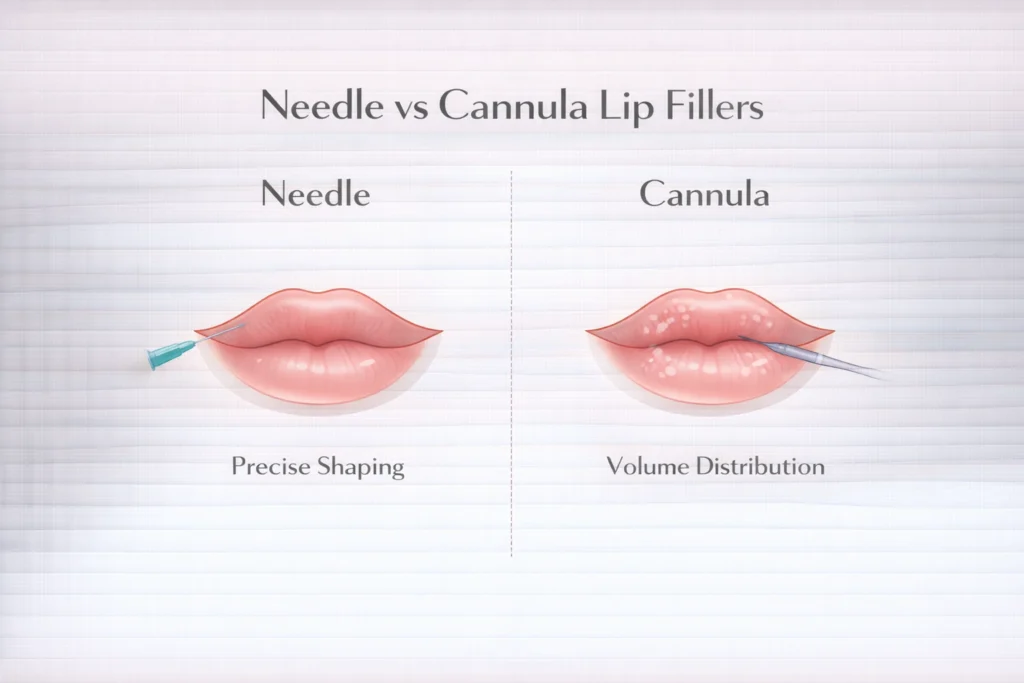
Practitioners use different tools based on the desired result and safety considerations. A needle allows for precise definition and shaping of the Cupid’s bow. A cannula is a blunt-ended tube that slides under the skin; it is often considered safer regarding blood vessels and tends to cause less bruising, though it may be less effective for crisp detailing.
Biggest Lip Filler Myths
Misinformation spreads quickly, often creating unnecessary fear or unrealistic expectations. Let’s correct the most prevalent myths circulating in the UK.
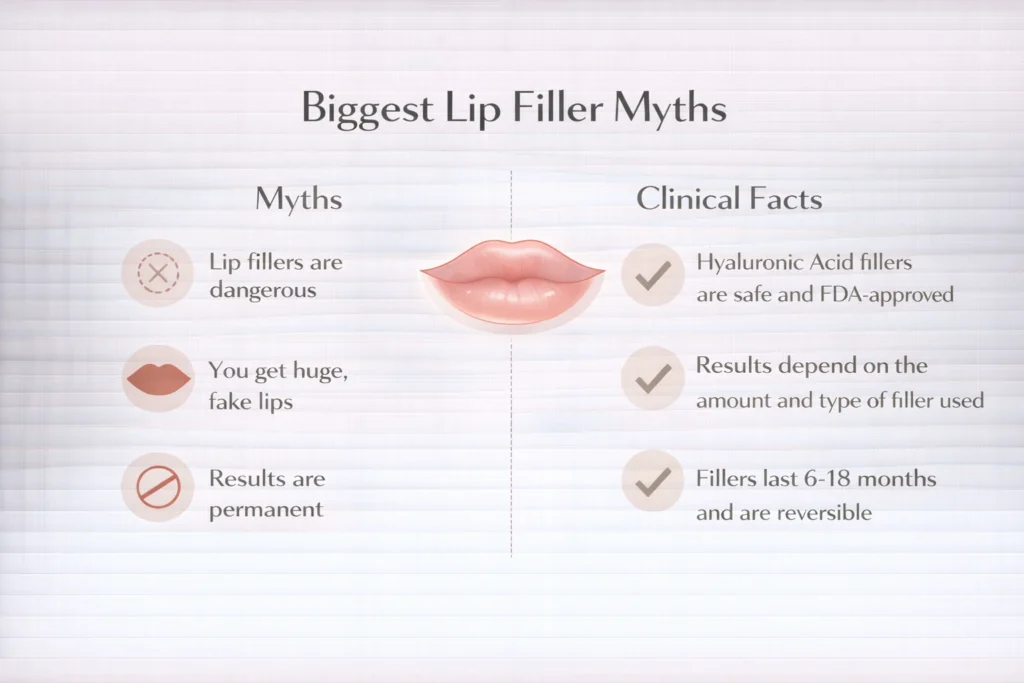
| Myth | Clinical Reality |
|---|---|
| Lip fillers always look fake | Natural results depend on conservative technique and correct volume |
| Bigger lips last longer | Longevity depends on metabolism and product type, not size |
| Cheap filler is the same | Product quality and practitioner skill directly affect safety |
| Once you start, you can’t stop | Filler dissolves naturally over time if not maintained |
| Massage fixes all lumps | Persistent lumps require professional assessment |
Myth: Lip fillers always look fake.
Reality: The “trout pout” or “duck lips” are examples of bad work, not the standard outcome. When performed correctly, fillers can be undetectable, simply making the lips look hydrated and rejuvenated. The best work goes unnoticed because it looks harmonious with the rest of the face.
Myth: Everyone can tell if you have had them.
Reality: We only tend to notice filler when it is done poorly or excessively. Thousands of people walk around with subtle enhancements that are assumed to be natural genetics. If the anatomy is respected, the result should not be obvious to the casual observer.
Myth: Only influencers get them.
Reality: The patient base is incredibly diverse. It includes professionals, parents, retirees, and students. Many people seek fillers not to look like a social media star, but to correct asymmetry that has bothered them for years or to address thinning lips associated with menopause.
Myth: One treatment changes your whole face.
Reality: 0.5ml or 1ml of filler is a very small volume—1ml is roughly one-fifth of a teaspoon. While it can enhance the lips, it rarely dramatically alters the entire facial structure in a single session. Significant changes usually require multiple treatments over time.
Myth: Cheap filler is the same as expensive filler.
Reality: Premium filler brands invest heavily in research, clinical trials, and safety data. They often have smoother consistency and better integration with tissue. Cheaper, unregulated, or counterfeit products may carry higher risks of reaction, lumpiness, and shorter longevity. In aesthetics, price often reflects the quality of the product and the skill of the practitioner.
Myth: Bigger lips last longer.
Reality: Volume does not equal longevity. Overfilling lips does not mean you can go longer between appointments; it simply means the lips are overfilled. Longevity is determined by the cross-linking technology of the hyaluronic acid, not the amount injected.
Myth: Once you start, you can’t stop.
Reality: You are not locked into a lifetime of maintenance. You can have one treatment and never have another. Your lips will not be “ruined”; they will simply return to how they were.
Myth: Massage fixes all lumps.
Reality: While massage is often advised for minor irregularities in the first few days, vigorously massaging lips without professional instruction can move the filler into unwanted areas (migration). Persistent lumps need professional assessment, not DIY massage.
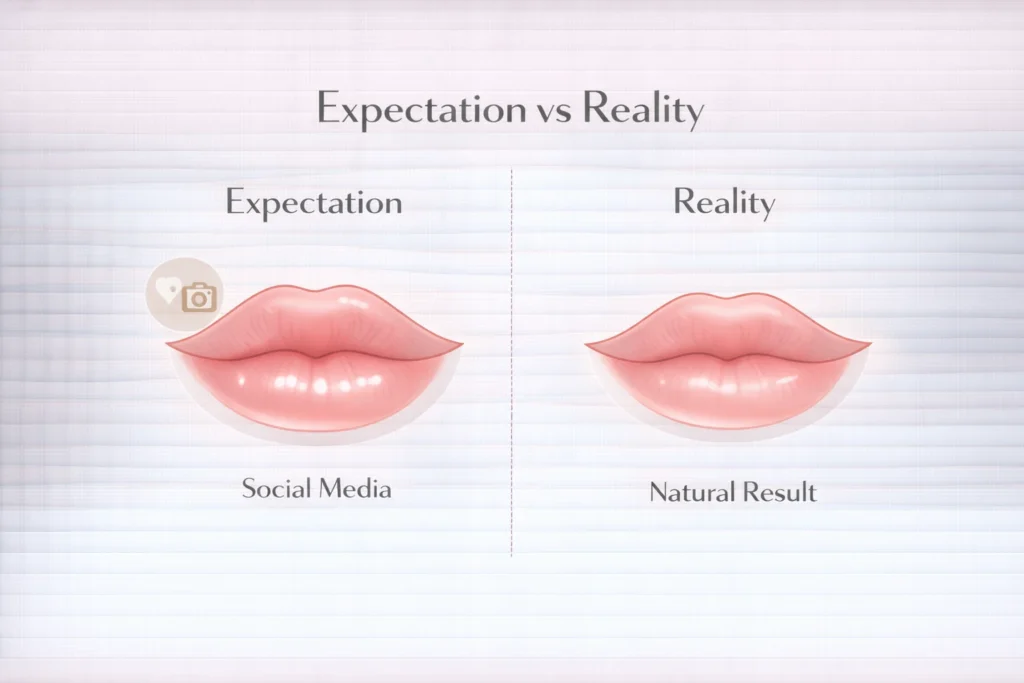
Expectations vs Reality
Managing expectations is crucial for satisfaction. The gap between what a patient imagines and the clinical reality can be significant.
- Pain Expectations: Many expect agony.
Reality: It is generally uncomfortable but tolerable. The lips are sensitive, but numbing agents are highly effective. The sensation is often described as a strange pressure rather than sharp pain. - Swelling Expectations: Patients often expect to look normal the next day.
Reality: Swelling is inevitable. For 24 to 48 hours, lips may look significantly larger than the final result, potentially uneven, and possibly bruised. Planning treatment around work or social commitments is essential. - Longevity Expectations: Many believe fillers last exactly 12 months.
Reality: The body metabolises filler at different rates. For active individuals with fast metabolisms, it might last six months. For others, traces may remain for over a year. It is not an exact timer. - Natural Look Expectations: Patients often bring photos of celebrities.
Reality: Your underlying anatomy dictates your results. If you have thin lips, you cannot achieve the volume of someone with naturally full lips in one session—or perhaps ever—without looking distorted. A practitioner works with your unique canvas. - Maintenance Expectations: “I’ll just get them done once.”
Reality: To maintain the result, repeat treatments are necessary. However, relying on frequent top-ups can lead to “filler fatigue” or migration. The reality of maintenance is often less frequent than people assume; waiting for the previous filler to break down somewhat is healthier for the tissue. - Social Media vs Real Life: Photos are static; real life is dynamic.
Reality: Lips that look perfect in a pouted selfie may look stiff or unnatural when speaking or smiling. A good practitioner prioritises how the lips look in motion, not just in a still image.
Social Media Influence & Misconceptions
Social media platforms are the primary driver of aesthetic trends, but they are also a source of skewed reality. The “Instagram Face” phenomenon has normalised a specific aesthetic—high cheekbones, sharp jawlines, and full lips—that is often achieved through filters rather than biology or good clinical practice.
Filters vs Real Results
Many images tagged as “lip filler results” are heavily edited. Skin smoothing filters remove texture, and warping tools adjust proportions. This creates an impossible standard where patients expect zero texture, lines, or pores on their lips, which is anatomically impossible.
Trend-Driven Lips
Trends like “Russian Lips” or “Keyhole Lips” sweep through platforms like TikTok. While these techniques can look striking in photos, they carry higher risks of migration and can look unnatural in profile. Medical professionals often warn against chasing specific named trends, as they may not suit every face shape.
Overfilled Celebrity Lips
When public figures display rapidly changing facial features, it normalises the idea of drastic transformation. However, audiences rarely see the downtime, the complications, or the dissolving procedures that often happen behind the scenes.
The “Quick Fix” Narrative
Short videos compress the treatment journey into 15 seconds—injection, wipe, perfect result. They omit the consultation, the medical consent process, the swelling phase, and the healing timeline, framing medical aesthetics as casual beauty treatments comparable to a haircut.
Psychological & Confidence Questions
Why do people choose to alter their lips? The reasons are rarely vanity alone; they are often deeply psychological and personal.
Confidence
For many, thin or asymmetrical lips have been a lifelong insecurity. Correcting a specific imbalance can offer a significant boost in self-esteem, allowing individuals to feel more comfortable in social situations or when being photographed.
Balance
The face is viewed as a whole. Sometimes, a patient has strong facial features (like a prominent nose or chin) and feels their lips are visually “lost.” Subtle enhancement can bring harmony to the facial profile, rather than simply making the lips “big.”
Ageing Concerns
As we age, we lose bone density and collagen. The lips naturally thin and turn inward (inversion), and the philtrum (the space between nose and lip) lengthens. Restoration fillers aim to return the lips to how they looked ten years prior, rather than creating a new shape, helping patients feel they look “fresher.”
Trend Influence
It is undeniable that fashion plays a role. Just as eyebrow shapes change by the decade, lip preferences shift. Acknowledging this external pressure is a healthy part of the decision-making process.
Who Should Think Carefully Before Getting Fillers
While lip fillers are widely accessible, they are not suitable for everyone. A responsible approach involves self-reflection and honest consultation.
Unrealistic Expectations
If a patient expects a treatment to fix a failing relationship, secure a job, or make them look exactly like a celebrity, they are likely to be dissatisfied. Fillers change physical features, not life circumstances.
Trend Pressure
If the desire for fillers comes solely from seeing them on friends or feeds, rather than a personal desire held over time, it is wise to wait. Trends change; your face is constant.
Very Young Patients
While 18 is the legal age, facial maturity continues into the early 20s. Rushing into permanent or semi-permanent alterations immediately upon turning 18 can lead to regret as personal style and facial features settle.
Body Dysmorphia Concerns
Body Dysmorphic Disorder (BDD) is a mental health condition where a person spends a lot of time worrying about flaws in their appearance. These flaws are often unnoticeable to others. Aesthetic treatments rarely resolve BDD and can exacerbate the obsession. Ethical practitioners screen for this and may decline treatment, suggesting psychological support instead.
Rushing Into Treatment
Decisions made on impulse, perhaps due to a limited-time discount offer, are often regretted. Aesthetic medicine requires a cooling-off period to consider the risks and implications.
Public Safety Awareness (UK Focus)
The regulatory landscape in the UK is distinct from other countries. Currently, the UK non-surgical aesthetic industry is surprisingly unregulated compared to the NHS. This makes patient awareness critical.
Dermal fillers in the UK are regulated as medical devices by the MHRA, but the person administering them does not legally have to be medically qualified, which is why patient due diligence is essential.
Importance of Trained Practitioners
Legally, in the UK, non-medics can administer dermal fillers. However, medical professionals (doctors, dentists, nurses, prescribing pharmacists) are accountable to regulatory bodies (like the GMC, GDC, or NMC). They are trained in anatomy, physiology, and, crucially, how to manage medical emergencies.
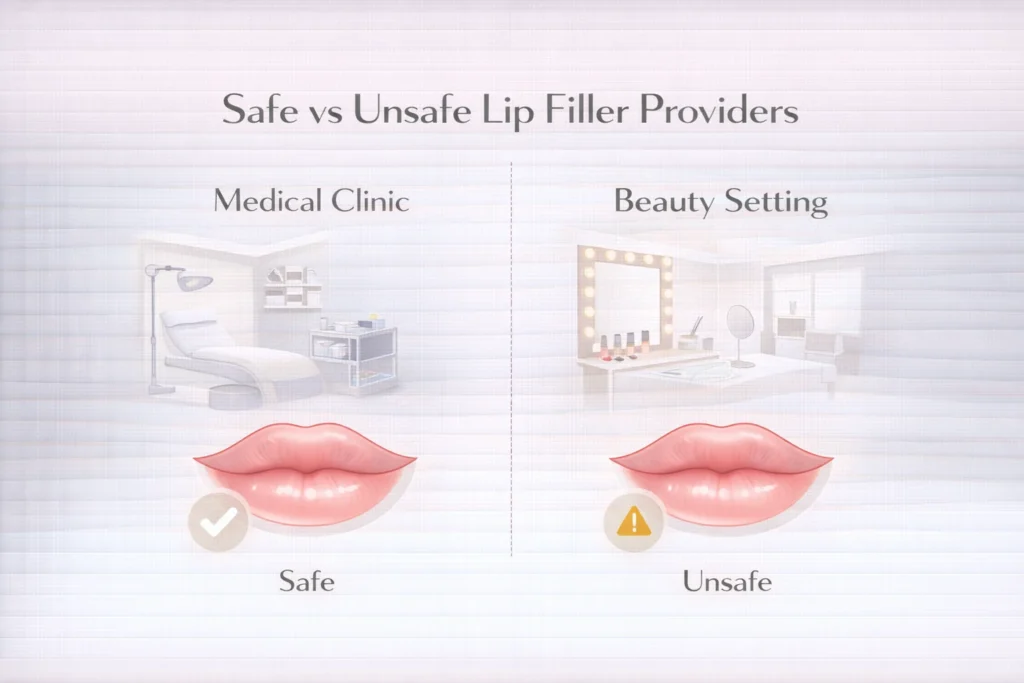
Medical Setting vs Beauty Setting
Lip filler is a medical procedure involving the compromise of the skin barrier and the introduction of a foreign body. It carries risks of infection. Clinical environments are designed to maintain sterility and have emergency protocols in place (such as adrenaline and hyaluronidase) that a home salon or beauty counter may lack.
Consultation Importance
A consultation is not just a chat; it is a medical assessment. It should cover medical history, allergies, medications, and mental health. If a practitioner skips the consultation or tries to inject you within minutes of meeting, this is a red flag.
Avoiding Rushed Decisions
Safe practice involves a cooling-off period. You should never feel pressured to book on the day. Reputable clinics will encourage you to go home and read the consent forms before committing.
Access to Emergency Care
Before treatment, ask: “What happens if something goes wrong out of hours?” A safe practitioner will have a plan for complications, including being reachable evenings and weekends if you suspect a vascular occlusion (blocked blood vessel).
Note: “UK safety organisations including the NHS, British Association of Aesthetic Plastic Surgeons (BAAPS), and the Joint Council for Cosmetic Practitioners (JCCP) consistently advise that dermal filler treatments should only be carried out by appropriately trained professionals in safe clinical environments to minimise avoidable risk and ensure access to emergency care if required.”
When Lip Fillers May Not Be Right For You
There are specific medical and lifestyle scenarios where postponing or avoiding lip fillers is the prudent choice.
Lifestyle Factors
If you play wind instruments professionally or participate in contact sports where facial impact is likely, fillers may present practical issues. Similarly, if you cannot commit to the aftercare (avoiding makeup, heat, and exercise for set periods), the risk of infection increases.
Budget
Fillers are an ongoing financial commitment. If the cost of the treatment stretches your finances, the cost of maintenance—or worse, the cost of correcting a complication—may be unmanageable. It is safer to wait until finances are stable than to seek the cheapest provider.
Natural Preference
If you are generally low-maintenance with your appearance and dislike the idea of needles or foreign substances in your body, the psychological toll of having filler might outweigh the aesthetic benefit.
Fear of Injectables
While anxiety is normal, genuine needle phobia can make the procedure traumatic and dangerous if the patient moves suddenly.
Medical Reasons
Certain autoimmune conditions, bleeding disorders, or active infections (like a cold sore) are contraindications. Pregnant or breastfeeding women should not undergo treatment, as clinical trials have not established safety for the baby.
FAQ SECTION
Here are answers to specific, functional queries often searched by prospective patients.
Q: Are lip fillers worth it?
A: This is subjective. For those with specific insecurities about asymmetry or volume loss, satisfaction rates are high. For those seeking a life-changing transformation, the subtle nature of fillers may be underwhelming.
Q: How long do lip fillers take?
A: The injection process takes 15–30 minutes, but the appointment should last 45–60 minutes to include consultation, numbing, and aftercare explanations.
Q: Can lip filler be removed?
A: Yes, hyaluronic acid fillers can be dissolved with hyaluronidase. However, this is a medical procedure with its own risks (such as allergic reaction) and should not be used casually.
Q: Do fillers stretch lips?
A: If filled gradually and respectfully, the skin accommodates the volume. If overfilled rapidly and maintained at a high volume for years, the skin can stretch, potentially looking lax if the filler is later dissolved.
Q: Can you kiss after lip fillers?
A: It is advised to avoid kissing for 24 hours to prevent infection and to stop pressure from displacing the settling product.
Q: Can you fly after lip fillers?
A: It is generally safe, but changes in cabin pressure can exacerbate swelling. It is often recommended to wait 24–48 hours before flying.
Q: Can lip fillers migrate?
A: Yes. “Migration” occurs when filler moves outside the vermilion border (the lip edge), often creating a “moustache” shadow. This is usually caused by poor placement, overfilling, or incorrect product choice.
Q: What happens if you stop?
A: The filler gradually breaks down. Your lips will slowly return to their original volume. They will not turn into “raisins” unless they were extremely over-expanded.
Q: Do they age you?
A: Done correctly, they can rejuvenate the face. Done poorly (overfilled), they can distort facial proportions, which can sometimes make a younger face look older or “done.”
Q: Can they dissolve naturally?
A: Yes, the body produces its own hyaluronidase which breaks down the hyaluronic acid filler over months.
Q: Can you drink alcohol after fillers?
A: Alcohol thins the blood and can increase bruising and swelling. It is best avoided for 24 hours pre- and post-treatment.
Q: Do lip fillers feel hard?
A: They shouldn’t. Once healed, they should feel soft and indistinguishable from natural tissue. Hardness suggests a lump or superficial placement.
Q: Can you wear lipstick immediately?
A: No. The injection points are tiny open wounds. Makeup can introduce bacteria. Wait at least 12–24 hours.
Q: Do fillers help smoker’s lines?
A: Yes, small amounts of filler can support the lip border and smooth out vertical lines around the mouth.
Q: Are there different types of filler?
A: Yes. Thick fillers are used for structure and volume; thin, fluid fillers are used for hydration and older patients. A skilled practitioner selects the density to match the patient’s tissue.
Q: What is a ‘lip flip’?
A: This uses botulinum toxin (Botox) to relax the muscle, flipping the lip outward slightly. It is not a filler; it adds no volume, only changes the resting position of the lip.
Q: Can you exercise after treatment?
A: Avoid strenuous exercise for 24-48 hours. Elevated heart rate and blood pressure can increase swelling and bruising.
Q: How do I find a good practitioner?
A: Look for medical qualifications, check the registers (GMC/NMC/GDC/GPhC), view healed before-and-after photos (not just fresh ones), and read independent reviews.
Q: What is vascular occlusion?
A: This is a rare but serious complication where filler blocks a blood vessel. It causes severe pain and skin blanching (turning white). It requires immediate emergency dissolving.
Q: Do lip fillers ruin your smile?
A: They shouldn’t. However, overfilling can make the lip stiff and hide the teeth when smiling. Good placement maintains the dynamic movement of the mouth.
Realistic Lip Filler Outcomes: What Most Patients Experience
Most patients who choose lip fillers are not seeking dramatic transformation but rather subtle refinement. In clinical practice across the UK, the majority of treatments focus on improving hydration, restoring lost definition, or correcting minor asymmetry rather than creating noticeably larger lips.
Final results typically settle within two to four weeks once swelling resolves and the filler integrates with the natural tissue. When performed conservatively and reviewed regularly, lip fillers can maintain natural movement, expression, and balance with surrounding facial features.
Making an Informed Personal Decision
Choosing whether to have lip fillers should always remain a personal decision rather than a response to external pressure. Trends, social media influence, and changing beauty standards can create unrealistic expectations, but aesthetic treatments are most satisfying when they align with individual preferences and long-term comfort.
Taking time to research, reflect, and consult a qualified professional allows decisions to be made with clarity rather than urgency. A well-informed choice is more likely to result in outcomes that feel natural, appropriate, and personally satisfying.
If you are still researching treatment safety, results, or procedure details, you may also find it helpful to read our detailed guides on lip filler safety, longevity, and the full lip filler procedure to build a complete understanding before making any decision.
Final Educational Summary
Deciding to undergo lip augmentation is a personal choice that should never be taken lightly. While the procedure is common, it remains a medical intervention with real risks and biological implications.
The goal of any aesthetic treatment should be to enhance your confidence and wellbeing, not to meet an arbitrary standard set by social media trends. If you are considering lip fillers, the most valuable step you can take is to research thoroughly. Seek out a medically qualified practitioner who prioritises safety over sales, and who is willing to say “no” if the treatment isn’t in your best interest.
Remember, realistic expectations are the key to a positive outcome. Aesthetics is an art of subtlety, not transformation. By understanding the myths, the timeline, and the safety protocols, you empower yourself to make a decision that is right for your face, your health, and your lifestyle.