



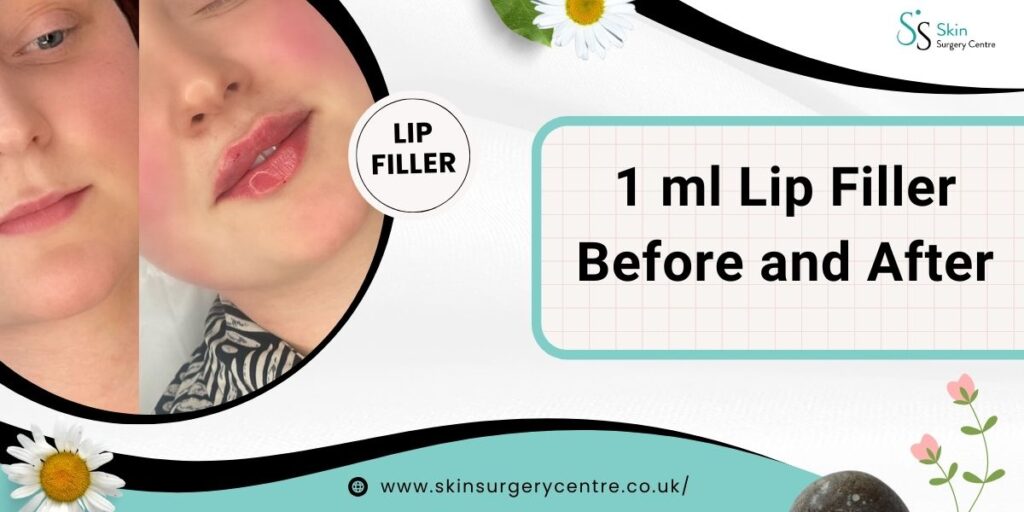
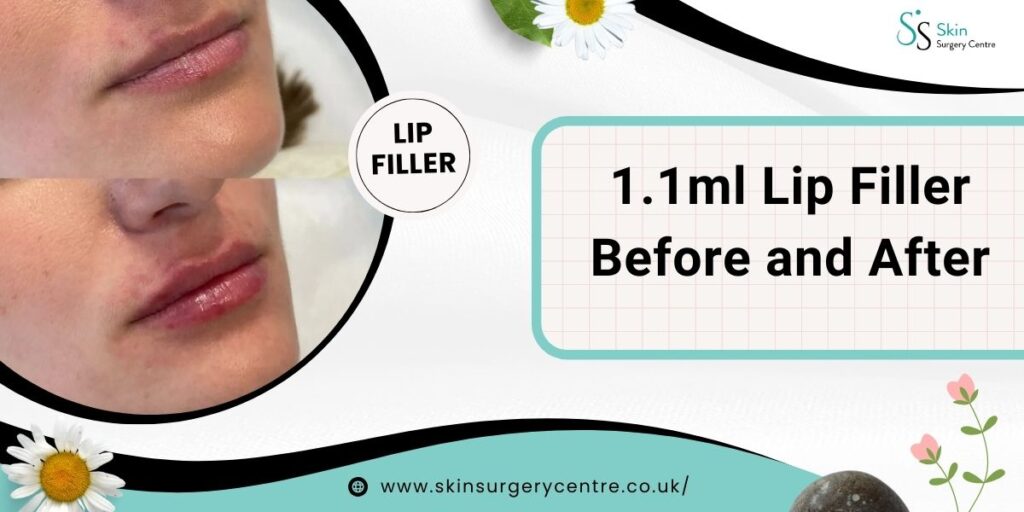
1.1 ml Lip Filler Before and After: What Results To Observe
Lip fillers have become one of the most sought-after non-surgical cosmetic enhancements due to their efficiency, customisability, and minimal downtime....
Firmness at the edge of the lips after filler is a common concern during the early healing phase. Many people notice that the border or outer edge of the lips can feel slightly hard or stiff after treatment, particularly in the first few weeks while swelling settles and the filler integrates with surrounding tissue.
If you are wondering why the edge of lips feels hard after filler, this is usually related to early swelling, product placement along the lip border, or temporary tissue firmness during healing.
In most cases, this firmness is temporary and improves gradually as the lips heal. Understanding why the edge of lips feels hard after filler, how long it usually lasts, and when professional review may be needed helps set realistic expectations and reduces unnecessary worry.
Mild firmness at the edge of lips after filler is usually part of the normal healing process after lip filler treatment. Swelling, temporary inflammation, and the physical presence of filler can make the lip border feel firmer or less flexible in the early stages.
In most cases, this sensation improves gradually over one to three weeks as swelling reduces and the filler integrates more naturally with surrounding tissue. Firmness that softens over time is generally reassuring, whereas hardness that worsens, becomes painful, or remains unchanged may require professional review.
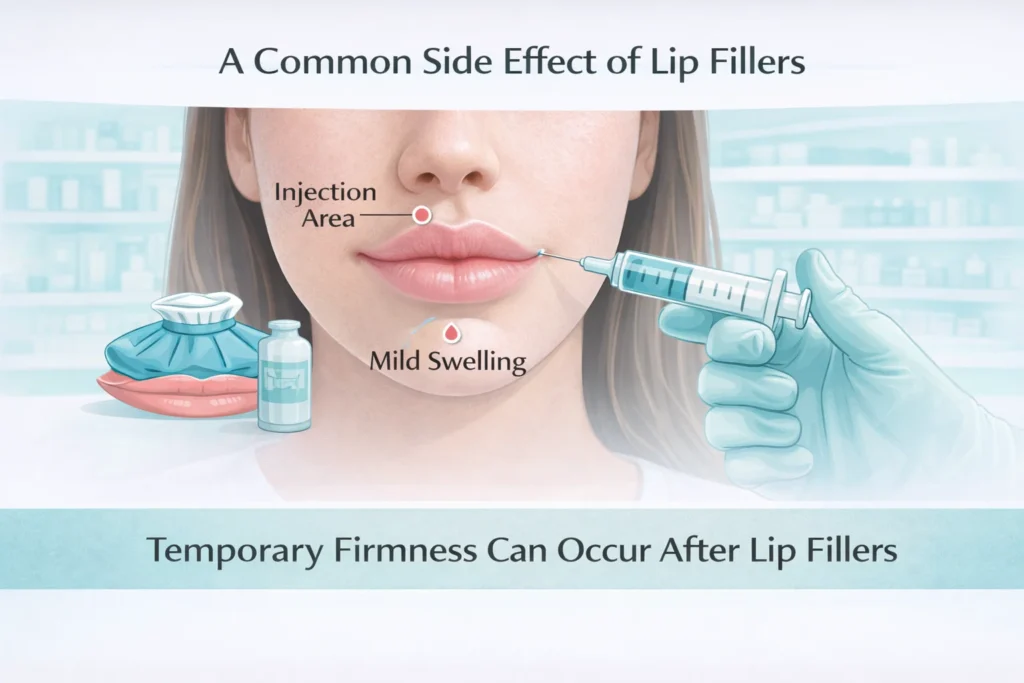
While many patients enjoy soft, natural results, others may experience the opposite — a firmer or harder feel post-procedure: lips feeling stiff after getting fillers.
Most lip fillers used in current UK aesthetic practice are hyaluronic acid-based products designed to be temporary and reversible. As with any injectable treatment, temporary side effects such as swelling, bruising, or firmness can occur during the settling phase.
Swelling occurs as part of the body’s natural inflammatory response to injection and usually settles within several days, although mild firmness can persist slightly longer while the filler integrates with surrounding tissue.
Read More: Lumps After Lip Filler at 2 Weeks: What’s Normal and When to Worry
In some cases, lumpiness or unevenness on the lips may occur if the filler isn’t distributed evenly and appropriately.
Even though it can usually be fixed with adjustment or massage, irregular filler distribution may contribute to localised firmness in certain areas of the lips.
Excess product placement can occasionally lead to areas of increased firmness or heaviness within the lips. Conservative treatment planning and gradual volume adjustment are generally preferred in UK aesthetic practice to maintain softness and flexibility.
A few factors can explain why your lips could feel denser or firmer than expected after treatment, even if it is just for a short period of time.
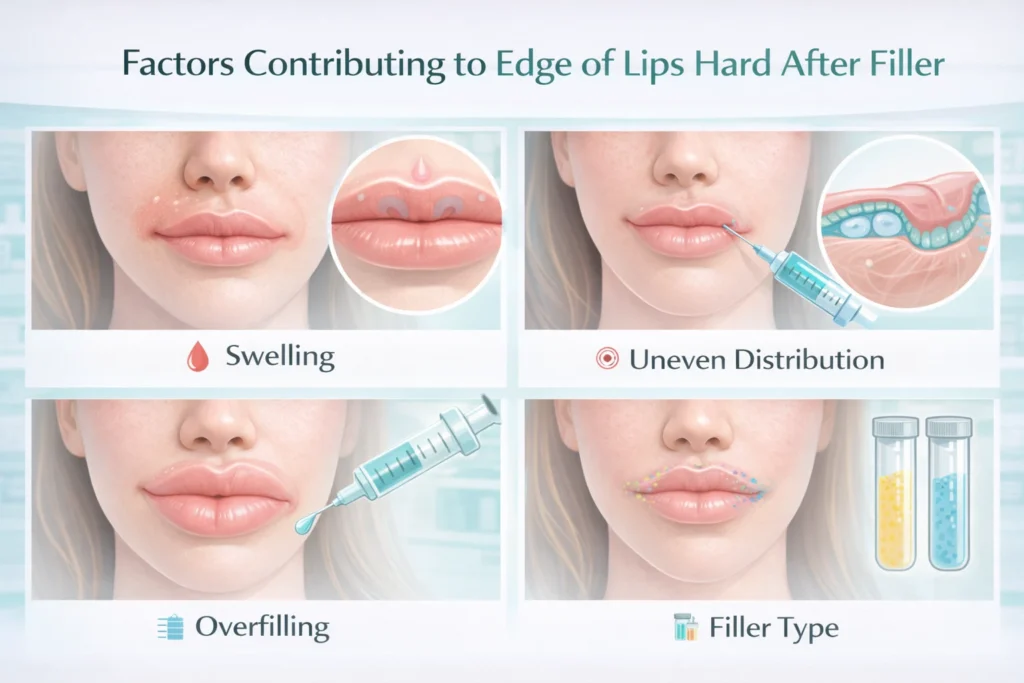
As more filler is injected, the chances of initial firmness increase. For those patients that are trying to have a more natural look, a conservative approach is always the best option. This is especially true for first timers.
The skill set of the injector greatly determines the outcome of your procedure. Less precise placement technique can sometimes contribute to areas of uneven firmness or texture. A skilled injector will strategically place the filler so you get a soft, natural result.
Fillers are different. Some are more volumetric and structural, thus resulting in a firmer texture, while others are less thick and more flexible and lead to a much softer outcome.
It’s best to speak to your provider regarding the best technique tailored to achieving your desired look and feel.
Everyone’s response to filler injections is different. The way your lips will feel during recovery will depend on a variety of factors like your sensitivity to the skin, propensity to swell, and how flexible your lip tissues are.
The vermilion border (the defined edge between the lip and surrounding skin) is a common area for precise filler placement to enhance lip definition. Because this area involves structured placement close to the lip margin, it may feel firmer than the central lip during early healing.
Temporary firmness along the lip line is often related to swelling combined with product sitting along the border for contouring. As swelling reduces and the filler integrates, this firmness usually softens gradually.
In cases of moderate lip filler usage, your lips should not lose their softness forever. Repeated treatments over time may influence tissue behaviour in some individuals, although this varies and does not occur in every case. Treatment planning and appropriate intervals between appointments help maintain balanced, healthy tissue response.
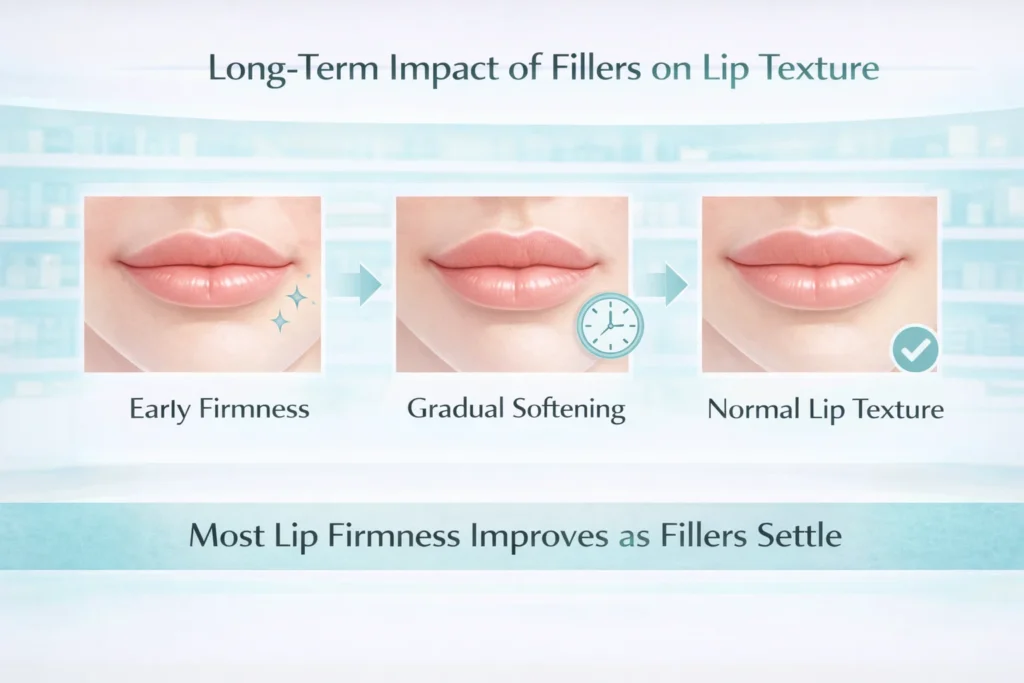
Very frequent or high-volume treatments without adequate review may influence how the lips feel over time. Conservative treatment planning and appropriate intervals are generally recommended to maintain balanced tissue response.
Choosing a reputable and experienced injector helps minimise the risk of uneven texture, firmness, or placement-related concerns. Such a professional will avoid harming the elasticity and softness of the lips while improving their volume and shape at the same time.
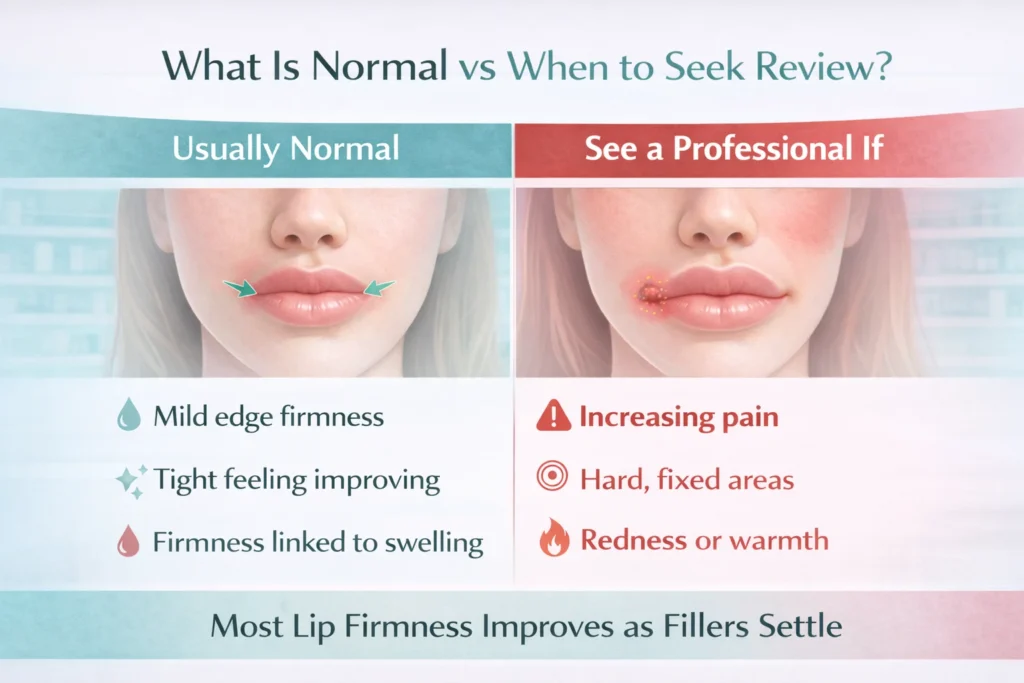
| Feature | Usually Normal After Filler | May Need Professional Review |
|---|---|---|
| Timing | First 1–3 weeks | Persisting beyond 3–4 weeks |
| Firmness feel | Gradually softening | Hard, fixed, not improving |
| Pain | Mild tenderness improving | Increasing pain or sensitivity |
| Skin changes | Normal colour | Redness, warmth, colour change |
| Action | Allow settling time | Seek practitioner assessment |
When uncertain, professional assessment is safer than waiting.
In UK clinical practice, temporary firmness or uneven texture after lip filler treatment is commonly reviewed during follow-up appointments. Most experienced practitioners advise allowing adequate settling time before assessing final texture, as early firmness is often related to swelling rather than the filler itself.
Most UK practitioners follow safety guidance aligned with MHRA standards and recognised complication management protocols when assessing post-filler concerns.
If your lips remain lumpy or hard following treatment, this is typically temporary and can be managed effectively with professional intervention. Solutions are available.
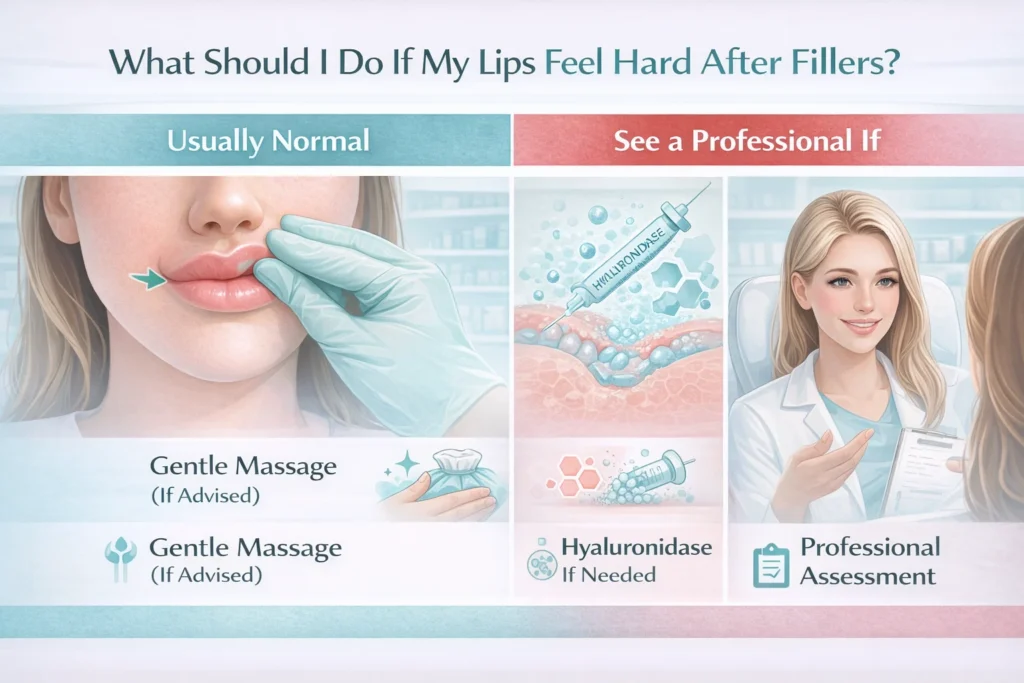
After injections, a light massage may be required in order to smoothen the irregularities by redistributing the filler. You can only do this if your practitioner gives the go ahead.
Massage or dissolving treatments should only be carried out under professional guidance. Incorrect self-manipulation can worsen firmness or displace filler. Conservative management and review are preferred before intervention.
For cases where there is overfilling or poor distribution of products, a practitioner may advise the use of hyaluronidase injections as it is an enzyme that dissolves the hyaluronic acid fillers and enables the lips to become soft again.
Lips may feel a little tight immediately after the procedure is done. Allow up to four weeks for your lips to settle and for the filler to fully integrate and swelling should go down. Any further action can be considered only after the period is completed.
Professional review is usually only needed if hardness becomes increasingly painful, remains unchanged beyond several weeks, or is associated with colour change or warmth.
Early review is appropriate if firmness is associated with increasing pain, spreading redness, colour change, or persistent hard nodules that do not soften.
Following specific aftercare tips can support normal healing and settling of the filler.
Some firmness will be noticed right after the procedure. This will fade out over a few weeks as lips get more hydrated and the filler merges into your tissues.
Hyaluronic Acid fillers soften facial tissues by drawing moisture to your lips. Try to avoid using a straw as it can disturb the filler and prolong recovery. Always ensure moisturisation is maintained through the use of quality lip balm.
In the first week after the treatment, there should be some pressure avoidance and manipulation of the lips. Kissing is also not recommended as it can disturb the filler.
Feel free to contact your injector if you worry about the way your lips feel. They always have the best advice regarding care as well as other adjustments.
In most cases, firmness after lip filler is part of the normal settling phase. Allowing time for swelling to reduce and filler to integrate is usually advised before considering intervention.

Firmness at the edge of the lips after filler is usually temporary and improves as swelling settles and the product integrates with surrounding tissue. Most textural changes soften gradually within the first few weeks, although individual healing timelines vary.
If hardness becomes increasingly painful, remains unchanged, or is associated with colour change or warmth, professional assessment is recommended. When in doubt, review by a qualified aesthetic practitioner helps ensure appropriate care and reassurance.
A: Mild firmness usually improves within 1–3 weeks as swelling settles and filler integrates.
A: Yes. Temporary firmness at injection borders is common in early healing.
A: Increasing pain, colour change, or firmness that does not soften after several weeks should be reviewed.
A: If caused by product placement or excess filler, hyaluronidase may be used by a qualified practitioner.

Lip fillers have become one of the most sought-after non-surgical cosmetic enhancements due to their efficiency, customisability, and minimal downtime....
Are you considering ways to achieve fuller, well-defined, and more symmetrical lips with 1.1ml lip filler? Whether this is your...
For people who are thinking about having their lips done, one of the most common questions is, “How much does...
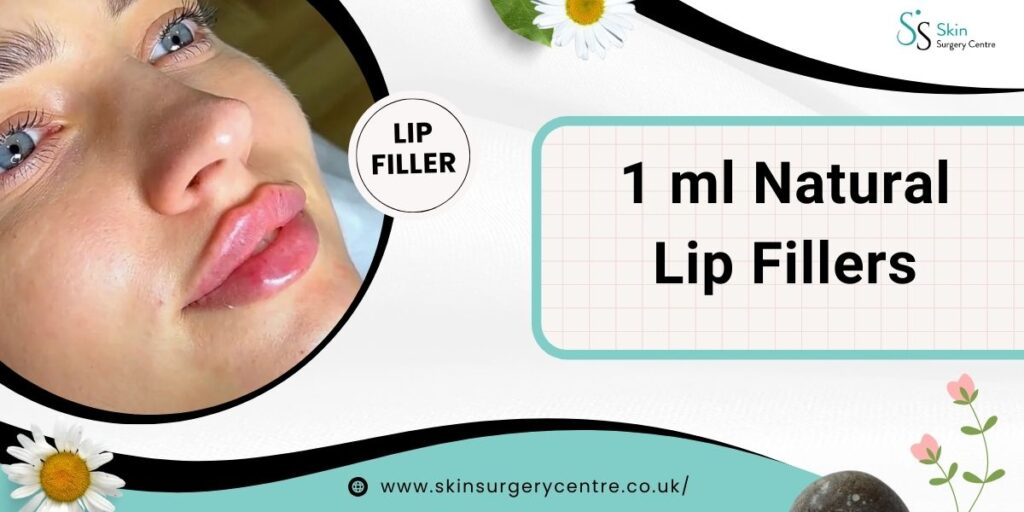
The aesthetic procedure 1ml natural lip fillers is gaining more popularity in this day and age. This particular measurement is...
According to Beauty Tech industry trends, lip augmentation continues to grow in popularity, and for good reason. If you are...